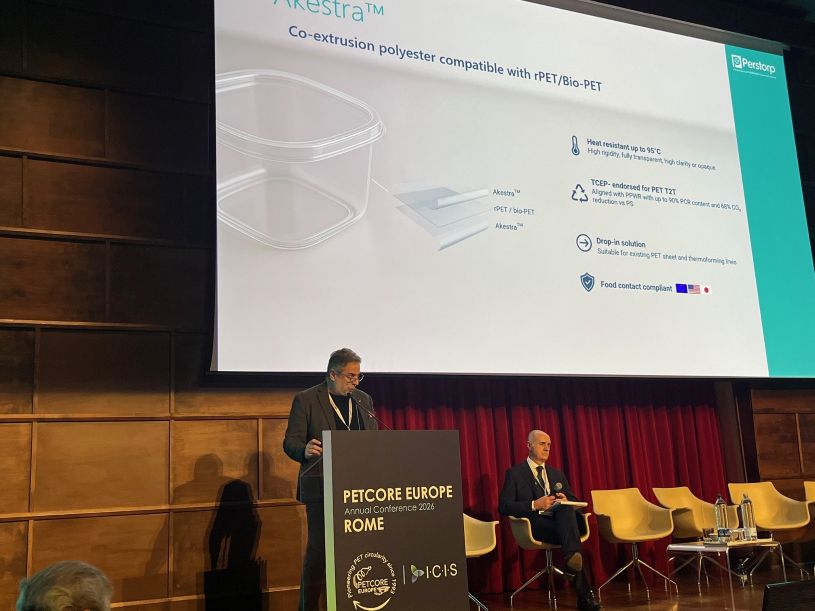
Key takeaways from PETCORE Europe 2026
At this year’s PETCORE Europe Annual Conference, stakeholders from across the PET value chain came together to tackle one of the industry’s most pressing questions: how do we move from circularity ambitions to systems that actually work at scale?
With representation from raw material suppliers, converters, recyclers, brand owners, technology providers and policymakers, the discussions made it clear that the transition to full PET circularity is underway, but not without friction.
Circularity means more than one recycling loop
One of the themes was a shift in how circularity itself is defined. Rather than focusing on single-loop recycling, the conversation increasingly centered on maintaining material quality across multiple cycles.
This was reflected in the European PET Bottle Platform’s (EPBP) work on Design for Circularity (DfC) guidelines. These go beyond traditional design-for-recycling approaches by setting higher expectations for how PET packaging should perform over repeated reuse and recycling loops. Future-ready packaging must be designed with longevity in mind, not just recyclability.
Regulation is shaping investment decisions
EU regulation featured prominently throughout the conference. With representatives from several EU institutions present, including DG GROW, DG Trade and DG SANTE, participants gained insight into the direction of policy development.
Discussions around the Packaging and Packaging Waste Regulation (PPWR), recycled content targets and compliance frameworks highlighted how regulatory clarity influences investment decisions. In particular, uncertainty around how chemically recycled PET will be counted towards EU targets remains a critical question for the industry. A takeaway was the need for harmonized, enforceable rules. Without them, even the most promising recycling technologies risk struggling to reach commercial viability.
Competitiveness and traceability are under pressure
While Europe continues to lead on circular economy ambition, the conference also exposed concerns around competitiveness. High collection and recycling costs, combined with increasing imports of PET and rPET, are putting pressure on European players.
Several speakers pointed to the need for improved traceability systems and trade codes to ensure imported materials genuinely meet EU standards. Without stronger safeguards, there is a real risk that local recycling capacity (essential for meeting circularity goals) could be undermined.
Innovation is moving from concept to application
Despite the challenges, the mood was optimistic. Innovation sessions showcased tangible progress in both mechanical and advanced recycling, as well as digital tools such as AI-driven quality analytics and traceability solutions.
Quality remains a decisive factor for food contact applications
One of the most technically focused and widely discussed topics was rPET quality, particularly for food contact materials. Issues such as NIAS, contaminants, evolving legislation (including EU 2022/1616 and the BPA ban), and public perception all featured heavily.
Encouragingly, new solutions are emerging to address consistency challenges, including additives designed to improve color control and oxygen management in rPET. These developments show that circularity and performance do not have to be mutually exclusive.
Collaboration is the real enabler
Perhaps the strongest signal from PETCORE Europe 2026 was the emphasis on collaboration. Working groups across design, reuse, certification and regulation are increasingly aligned around the same objective: reducing fragmentation and accelerating progress.
For Perstorp, the value of being present was reinforced not only through dialogue and networking, but also through recognition. Seeing Akestra™ highlighted as one of PETCORE’s TCEP success cases came as a confirmation that advanced material solutions have a concrete role to play in enabling future-proof PET packaging across the value chain.
Looking ahead
The conference made it clear that the journey toward full PET circularity is as much about execution and alignment as it is about ambition. Regulation, technology, quality and competitiveness are deeply interconnected and progress will depend on how effectively these pieces come together.