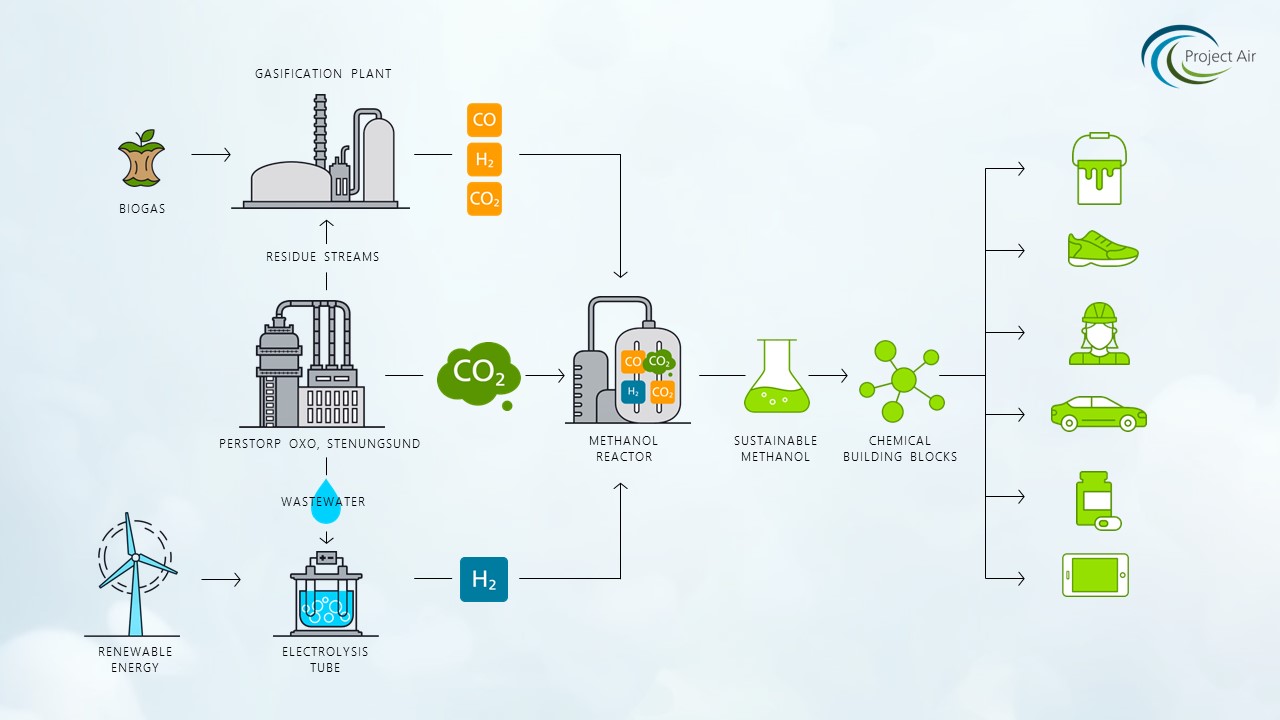
How it works
Project Air utilizes a combination of a carbon capture and utilization (CCU) process for converting captured CO2, residue streams, renewable hydrogen and biomethane, which is to be applied for the first-of-a-kind, large-scale production of sustainable methanol.
Project Air is transforming how sustainable methanol can be produced on a large, industrial scale. By replacing 200,000 tons of fossil methanol used annually at Perstorp’s European sites, the project enables a 500,000‑ton reduction in CO₂ emissions every year.
Here’s how it works — step by step.
1. Capturing Carbon Instead of Releasing It
Perstorp captures CO₂ directly from its own operations using a Carbon Capture and Utilization (CCU) plant in Stenungsund, Sweden. This captured CO₂ becomes a valuable raw material in sustainable methanol production instead of being emitted into the atmosphere.
2. Turning Residue Streams Into Resources
Production residue streams rich in carbon and hydrogen are recycled and fed back into the process. These streams help create the feedstock needed for methanol, improving circularity and reducing waste.
3. Replacing Fossil Gas With Biogas
Biomethane, produced from waste in biogas plants, is converted into synthesis gas — a crucial ingredient in the methanol process. Because fossil natural gas is no longer an option for a climate‑neutral chemical industry, biogas becomes essential for making sustainable methanol possible.
4. Producing Renewable Hydrogen
Using purified wastewater and renewable electricity, Perstorp produces green hydrogen in its electrolysis plant. This hydrogen is another key building block in the chemical reaction that forms sustainable methanol.
5. Creating Sustainable Methanol at Scale
When combined — captured CO₂, residue streams, biomethane, and renewable hydrogen — these inputs enable the annual production of:
200,000 tons of sustainable methanol
- Lowering CO₂ emissions by 500,000 tons per year
- Reducing the footprint of thousands of end‑products
- Supporting a fossil‑free chemical industry
Why Biogas matters
A stable biogas supply is critical for Project Air’s success. Perstorp’s need for biogas will nearly double, from 1.5 TWh to almost 3 TWh per year. To meet future demand from industry, Sweden’s biogas production will need to increase from 2 TWh today to over 10 TWh — with even more required long‑term.
For Sweden to reach this level, the country needs:
1. A functioning biogas market for industry. Biogas production must grow, and industry must be recognized as a key consumer.
2. A level playing field. Stable, predictable, and competitive conditions — aligned with EU support schemes — are required to secure renewable inputs at viable prices.
Shaping the future of Sustainable Chemistry
Project Air has the potential to transform a large part of Sweden’s chemical industry.
By ensuring access to renewable raw materials at competitive prices, the project shows how fossil‑free production can become a reality — and scalable for the future.