Selected filters: No Filters Selected
showing 2669 result(s)
Filter(s)-

20 August 2020
Global Protein’s Uncertain (and Certain) Future
Global Protein’s Uncertain (and Certain) Future
Webinar
Animal Nutrition, Gut health
-

17 February 2023
Plasticizers
Perstorp offers high performing, innovative and versatile PVC plasticizer solutions, and we are continually looking to improve it. That’s because we know that PVC can be a valuable and valued resource if it is made, used, and disposed of thoughtfully.
Markets & Products
-

26 February 2021
Management strategies to improve swine welfare
European Veterinary Specialist in Animal Welfare Science, Ethics and Law, Ms. Déborah Temple, and Perstorp Perstorp Global Technical Manager Sofia Rengman shared their visions on the welfare and management of swine in this 1 hour webinar.
Webinar
Animal Nutrition, Gut health
-

19 August 2020
Nutritional strategies to raise nursery piglets without antibiotics
Webinar: Nutritional strategies to raise nursery piglets without antibiotics
Webinar
Animal Nutrition, Gut health, Feed hygiene, Feed acidification
-

23 April 2020
Things to consider when working with buffer capacity of feed
Things to consider when working with buffer capacity of feed
Webinar
Animal Nutrition, Feed acidification, Gut health
-
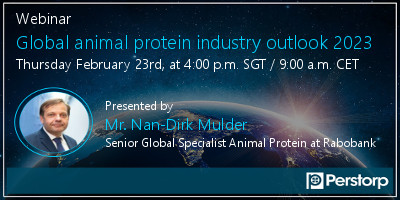
23 February 2023
Global animal protein industry outlook for 2023
Find out what the future has in store for the global meat production industry in 2023. In this one-hour webinar, Mr. Nan-Dirk Mulder, Rabobank's Senior Global Specialist in Animal Protein, elaborated on the best strategies for the rest of 2023 based on some thorough analysis and facts from Rabobank research reports. This webinar took place on Thursday, February 23rd, at 4:00 p.m. SGT / 9:00 a.m. CET.
Webinar
Animal Nutrition, Gut health
-
27 February 2019
Światowej klasy partner w dziedzinie innowacyjnych i elastycznych plastyfikatorów PCW
Markets & Products
-

05 September 2023
Driving productivity through optimal gut health
This webinar took place on the 5th of September 2023, at 15:00 SGT / 9:00 CET. During the webinar, you could explore the critical role that gut health plays in driving productivity and overall success in the poultry industry.
Webinar
Animal Nutrition
-

13 December 2023
Pig production: Dealing with the challenges in lactation
This webinar took place on the 13th of December 2023, at 10:00 AM CET. During this webinar, you could explore how optimizing lactation management not only leads to healthier piglets, but also results in more productive sows.
Webinar
-
10 November 2015
Perstorp committed to DPHP in North America
To increase support for its DPHP plasticizer customers in North America, Perstorp has secured a permanent storage tank for its Emoltene™ 100 (DPHP) plasticizer, which is expected to be operational from the beginning of 2016. The bulk tank located in New Jersey will result in shorter lead times and delivery times, and a very reliable supply of our Emoltene™ 100 (DPHP) to customers in this region.
Press Release
Valerox, Advanced Materials
Pattern Lab